20/05/2026
An Interview with Florian Naudet, Professor of Therapeutics at the University of Rennes, Open Science and meta-science expert, co-founder of GRIOS and Chair of its Academic Advisory Board.
By Maria Karatzia
In the clinic, Florian Naudet works with patients whose care depends on access to reliable and trustworthy evidence. In his research, he critically examines that evidence: what the scientific literature reports, what it omits, and what remains unverifiable when underlying data are not accessible.
This dual perspective, at the interface of care and research, shaped his engagement with open science. It is also what led him to help create GRIOS. “My interest in open science started because, as a clinician, I found that science was sometimes difficult to reach in order to make informed decisions,” he explains.
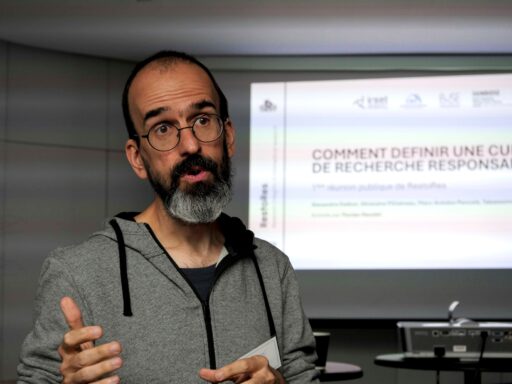
Florian’s route into open science began with a clinical question that continues to be widely investigated and, at times, remains contentious: the use of antidepressants in the treatment of major depressive disorder. “I work as a researcher on antidepressants, and one of the major issues in this field is publication bias,” he says. “If you rely only on the published literature, you simply don’t have enough information to accurately assess how effective these drugs really are.“
Publication bias was only the beginning. As he looked deeper, he uncovered further problems: outcome switching, poor reporting, and, ultimately, no access to the individual patient data underlying the trials. “None of them was available,” he recalls. What looked at first like a problem specific to psychiatry turned out to be something much larger. “Once I entered the field, I discovered that these issues weren’t limited to antidepressant or psychiatry research. They were widespread across most of medical research — and the same is true for most research in every field.”
That discovery pointed him toward what seemed the obvious remedy: “The most obvious solution is to say ‘let’s open everything’.” But open science is rarely that simple.
“It’s super difficult to make everything open, especially in medicine,” Florian notes. And even when openness is possible, it is not automatically useful: “You also need to make sure that opening data is impactful and that it produces the kind of impact you are hoping for.” That leads, he says, to further questions — about how best to open data, which strategies work, and whether researchers’ incentives are aligned with openness at all.
It’s super difficult to make everything open, especially in medicine. And even when openness is possible, it is not automatically useful. You also need to make sure that opening data is impactful and that it produces the kind of impact you are hoping for.
To illustrate, he tells the story of a colleague who studied “unicorns” — the billion-dollar start-ups whose funded research is almost entirely closed to the outside world. “Most of the research done by these start-ups does not appear in the medical literature,” he notes. “It may appear somewhere else — or not at all. And that could be a problem.“
A well-known example is Theranos, a US start-up that worked to develop tools to diagnose diseases but had no scientific output behind it, no publications — and turned out to be a big scam. On the same list of opaque unicorns that Florian’s colleague compiled was another name: Moderna. “At the beginning, Moderna was criticised for being closed, and one could have expected that nothing meaningful would come from it, in line with what happened with Theranos,” he reflects. “Yet Moderna later developed a vaccine and ended up saving millions of lives worldwide. So, the picture is much more complex.“
This is the question GRIOS is designed to address. “Is there evidence that open science actually makes a difference? It’s a question that isn’t asked often enough,” Florian observes. And even when answers do exist, he points out, they are not always acted on. He takes clinical trials as an example: a randomised study shows that a simple reminder to trial teams increases the rate at which they post their results on ClinicalTrials.gov — “yet this is not implemented,” he notes.
“This is why we need some sort of organisation able to assess the evidence — to define what is evidence-based and what is not,” he argues. “Where it’s not evidence-based, to set an agenda for future research. And where there is evidence, to summarise it and translate it into action. Because when evidence exists that something works, we should implement it. That’s where GRIOS can be useful.“
Is there evidence that open science actually makes a difference? It’s a question that isn’t asked often enough.
We asked Florian whether GRIOS, in effect, is diagnosing a ‘disease’ of research waste and testing a cure. “If we were ambitious, we could say that GRIOS aims to be preventive — because preventing the disease is always better than treating it,” he says. “Then it tries to be curative. And in the end, it also tries to be palliative, because science has its own terminal disease, not so easy to cure. I think we need all three approaches: to know what can prevent problems from occurring, what can treat them when they are here, and what can make things smoother when we cannot do more.”
Florian also points to a closer-to-home model. In medical research, he notes, researchers face very similar questions about drugs and treatments: “Which treatment works, in which condition, for which patient.” For that purpose, medicine has Cochrane — an organisation that set out to map every field of treatment and synthesise the evidence on each. “I think this could be a very nice example for GRIOS: implementing the best practices in review synthesis, synthesising the most important questions, and translating that into change if possible.“
Florian is clear that transparency on its own will not rescue research. “Transparency alone is not enough,” he explains. “If you are transparent about poor-quality research, it is not helpful at all — it might even be better for it to remain closed. You need rigour and transparency. Both are relevant.“
In evidence synthesis, he explains, there are well-developed tools for assessing the risk of bias in individual studies — tools that make it possible not just to gather evidence, but to weigh it, and to exclude studies when the risk of bias is too high to be informative. “It’s important that we are able to do the same for open science,” he adds.
Florian points to another piece of the puzzle: how researchers are rewarded. “There is a lot of debate that things are going wrong because incentives are not fully aligned with the goal of doing rigorous and transparent research,” he says. He counts himself close to the movement for research assessment reform, but with a caveat: the reform itself, he argues, needs to be evidence-based. “We need to be sure that what we change in the system actually leads to a transformative change in how research is done.“
And the goal, he adds, is not rigour and transparency for their own sake. “These are surrogate outcomes. At the end of the day, what we are really looking for is a better research ecosystem — and ultimately, a better world. That is much more difficult to define, but it is what we are after“.
Alongside his role as co-founder of GRIOS, Florian chairs its Academic Advisory Board — a body of leading scholars from nine countries across Europe, Africa and the Americas.
What is the role of the Board? “We are asking them to do so many things“, he replies. Board members review the topics proposed by the Steering Committee and give their expert opinion — ranking and refining the research questions that GRIOS takes on. They also act as peer reviewers of the work itself, evaluating proposed reviews to make sure they follow the best practices of evidence synthesis, and that both the framing of the question and the conduct of the review meet a high bar of quality. “They are stellar experts,” he adds, “from a very diverse range of fields — and from very diverse countries.“
That combination of breadth and geographic diversity matters a lot to him. “Data sharing, for instance, is not seen exactly the same way in the Global North and the Global South,” he explains. “There are issues of sovereignty: whether you have the infrastructure to keep data in the country, whether sending data abroad is tricky and complex. We need to take account of all perspectives — and this is why it is so important to have this kind of very large and diverse board.” And the stakes are concrete: a question that feels central to a researcher in medicine may look very different to a researcher in psychology, and data practices that work in one region may be unworkable in another.
Asked to name one thing GRIOS could achieve in the coming years that doesn’t exist today, Florian answers: “If we could push any kind of policymaker to adopt one evidence-based approach, it would be fantastic. Just one“
He offers an example from his own field: “In medicine, simply posting the results of clinical trials would already be a good success.” Where the evidence exists, GRIOS can help push decision-makers to act. Where it does not, GRIOS can make visible what is missing, so the research community knows where to look to start gathering evidence.
Florian acknowledges that the first output may be a map of research gaps on open science rather than a list of answers. “Even if, at the end of the day, GRIOS only comes up with gaps, we will have done a lot of work. It’s interesting to have a good gap map, and then to be able to implement research on those gaps.“
If we could push any kind of policymaker to adopt one evidence-based approach, it would be fantastic. Just one.
For researchers wondering how they can contribute, Florian’s message is direct. GRIOS has recently issued its first call for evidence synthesis reviews, and this is where the research community comes in. “One of the roles will be to perform the reviews,” he says. “Researchers are invited to apply — and they should not hesitate. This is the best way they can produce knowledge with GRIOS.“
What GRIOS is looking for, he adds, is not only willingness but method: people who understand what a systematic review is, how it should be done, and what the best practices in the field look like. “With this in mind, they are welcome to come and join.“
The first GRIOS call for scoping and systematic reviews is open. If you have experience in evidence synthesis and an interest in open science, this is your moment to get involved. Find the call details at:
The question GRIOS is asking is not whether open science matters, but whether it works — for whom, and with what evidence behind it.
Ready to be part of the conversation? Join us: https://www.grios.org/contact